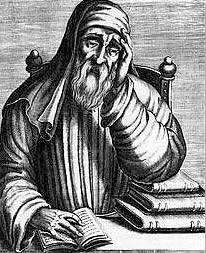
Longtime readers of this space know of my love for Plutarch and may have seen my "Plutarch Blog" at: http://2milejournal.blogspot.com/. After a short break, I am back at work on Brother Plutarch and will be posting on the "Moralia" pretty regularly. I urge you to visit periodically. I will also be posting from one of my all-time favorite books, "Emerson's Plutarch" by Edmund G. Berry. Why Plutarch? This from Emerson explains a bit...
"Go with mean people and you think life is mean. Then read Plutarch, and the world is a proud place, peopled with men of positive quality, and with heroes and demigods standing around us, who will not let us sleep."
If it naive to want to believe in the world as a "proud place" when all about it appears "mean" then count me among the naive...
Blessings
Friday, December 30, 2011
Monday, December 19, 2011
misappropriation and superficiality...
Readers of this space know that I love Ralph Waldo and the Transcendentalists. This, however, is a love that is not blind. The fascinating Orestes Brownson (as discussed by Arthur Verslouis in his "American Transcendentalists and Asian Religions" gets to the heart-or at least one of the hearts-of areas where RWE and the gang give me pause. Brownson, of course, carved his way through the liberal Protestant landscape before embracing authority and the Roman Catholic Church...
"In brief (writes Verslouis) Brownson's criticism is that Transcendentalism takes rhetorically for itself the highest stations attainable within the various traditions and offers no effective means for realizing those stations. And in this respect Brownson's critique is indeed valuable, as each of the traditions on which Emersonian Transcendentalism draws depends on following a particular path. So if one were to choose among its teachings without having followed that path, one could certainly be accused of doing the given tradition an injustice. Much better, says Brownson, to enter into one of those paths-in particular, that of the church-and to follow it. One at least avoids the sin of misappropriation and superficiality."
Blessings
Wednesday, December 14, 2011
life is but a dream sweetheart...
My posting recently has been sporadic which means, unfortunately, the same for my devotional life. One idea, however, has been going around in my head the past few days. I am reading much right now on the Transcendentalists and "Asian Religions" (right now Arthur Versluis', "American Transcendentalism and Asian Religions'" and a persistent issue is Emerson's perceived romantic self-centerdness. Verslouis writes of Emerson's use of the idea of Maya and "illusion" to "transcend" this problem:
"...there is another subtle but important ramification to his affirmation of maya's or illusion's, universality: Through this recognition of the universality of illusion, Emerson is able to affirm the illusory nature of the individual self as well and thus to avoid the tendency toward solipsism that so haunts English and to some extent European Romanticism. After all, the logical conclusion of the doctrine of maya must be that the individual ego is also contigent, that if the external world is a dream, then so are we ourselves. If the essence of the Romantic fallacy was the psychologizing internalization of religious truth, then by denying the ultimate reality of the ego, Emerson is effectively transcending the fundamental trap of Romanticism.
According to Emerson, man is truly man only when he transcends his limited self; man is meant to be more than man, to be a 'transparent eyeball' (using an echo of a Plotinian phrase), to be a 'god' sitting among 'gods,' or not to be an 'I' at all. Many critics have suggested that Emerson was fundamentally an egoist, and no doubt this is true, for as Nakagawa Soen Roshi once said, we are all egoists. But insufficient attention has been paid to Emerson's focus on transcending the self, for it is here, on the poet's illuminaation or inspiration, that Emerson's works are often actually centered. Pivotal here are Platonism and the Vedanta."
The line between self absorption and self transcendence is a fine line indeed and maybe the chief role of religion is to illuminate that line...
Blessings
"...there is another subtle but important ramification to his affirmation of maya's or illusion's, universality: Through this recognition of the universality of illusion, Emerson is able to affirm the illusory nature of the individual self as well and thus to avoid the tendency toward solipsism that so haunts English and to some extent European Romanticism. After all, the logical conclusion of the doctrine of maya must be that the individual ego is also contigent, that if the external world is a dream, then so are we ourselves. If the essence of the Romantic fallacy was the psychologizing internalization of religious truth, then by denying the ultimate reality of the ego, Emerson is effectively transcending the fundamental trap of Romanticism.
According to Emerson, man is truly man only when he transcends his limited self; man is meant to be more than man, to be a 'transparent eyeball' (using an echo of a Plotinian phrase), to be a 'god' sitting among 'gods,' or not to be an 'I' at all. Many critics have suggested that Emerson was fundamentally an egoist, and no doubt this is true, for as Nakagawa Soen Roshi once said, we are all egoists. But insufficient attention has been paid to Emerson's focus on transcending the self, for it is here, on the poet's illuminaation or inspiration, that Emerson's works are often actually centered. Pivotal here are Platonism and the Vedanta."
The line between self absorption and self transcendence is a fine line indeed and maybe the chief role of religion is to illuminate that line...
Blessings
Wednesday, November 30, 2011
to triumph over old age
Yesterday was the birthday of Amos Bronson Alcott, most infuriating of the Transcendentalists, who wrote...
"To keep the heart unwrinkled, to be hopeful, kindly, cheerful, reverent that is to triumph over old age."
Blessings
"To keep the heart unwrinkled, to be hopeful, kindly, cheerful, reverent that is to triumph over old age."
Blessings
Tuesday, November 29, 2011
the most dependent creature on earth...
Ephraim Peabody tells us that the more "advanced" a civilization becomes, the more dependent we humans become. Yesterday's Advent Sermon continued...
"1. I call attention to the general fact that every increase of faculty, though it increases power, involves also an increase of needs. The stone in the quarry has no needs whatsoever. The air folds it round about, the rains fall on it, the sunbeams glow and flame on its surface, but the rock remains impassive, needing none of them. The tree adds to dead matter the element of organizing life, and air, rain and sunshine are essential to its existence. With the added faculties of animal life come added and corresponding needs. In man there is a sudden and vast enlargement of faculty, but with it an equal multiplication of the points of dependence on what is external to himself. Man, the most powerful, is also the most dependent creature on earth. The general law follows him into the spiritual life. The brute has neither hope nor fear for the morrow; but man is tortured by remorseful memories, is racked by anxieties, is at the mercy of hope and fear, lives a needy mendicant on human affections, his soul is awed by conscious relations with God, he recoils from the mysteries of the grave, and treads with trembling the borders of the eternal world. He is in the midst of the vast agencies of Nature and of God, and by the very intelligence which raises him above the animal, is made conscious of his weakness and dependence. And now, going one step farther, I add, that the higher the culture, the greater the needs... One might almost describe civilization as a condition of multiplied needs—physically, mentally, morally, a condition of multiplied needs. It is no accident, but the merciful law of God, that the same civilization which develops individual power shall create the restraints of dependence and the humanizing influences of mutual needs. Thus culture invariably increases need. It awakens the sensibilities, it gives them a keener edge, it multiplies their demands, it carries a man out of himself, and connects his wellbeing with a constantly enlarging circle of influences external to himself—making him at the same time more self-subsistent and more dependent."
More tomorrow...
Blessings
"1. I call attention to the general fact that every increase of faculty, though it increases power, involves also an increase of needs. The stone in the quarry has no needs whatsoever. The air folds it round about, the rains fall on it, the sunbeams glow and flame on its surface, but the rock remains impassive, needing none of them. The tree adds to dead matter the element of organizing life, and air, rain and sunshine are essential to its existence. With the added faculties of animal life come added and corresponding needs. In man there is a sudden and vast enlargement of faculty, but with it an equal multiplication of the points of dependence on what is external to himself. Man, the most powerful, is also the most dependent creature on earth. The general law follows him into the spiritual life. The brute has neither hope nor fear for the morrow; but man is tortured by remorseful memories, is racked by anxieties, is at the mercy of hope and fear, lives a needy mendicant on human affections, his soul is awed by conscious relations with God, he recoils from the mysteries of the grave, and treads with trembling the borders of the eternal world. He is in the midst of the vast agencies of Nature and of God, and by the very intelligence which raises him above the animal, is made conscious of his weakness and dependence. And now, going one step farther, I add, that the higher the culture, the greater the needs... One might almost describe civilization as a condition of multiplied needs—physically, mentally, morally, a condition of multiplied needs. It is no accident, but the merciful law of God, that the same civilization which develops individual power shall create the restraints of dependence and the humanizing influences of mutual needs. Thus culture invariably increases need. It awakens the sensibilities, it gives them a keener edge, it multiplies their demands, it carries a man out of himself, and connects his wellbeing with a constantly enlarging circle of influences external to himself—making him at the same time more self-subsistent and more dependent."
More tomorrow...
Blessings
Monday, November 28, 2011
the culture of our higher faculties...
I have read a fair number of 19th Century Unitarian Sermons in my time and a recurring theme, I think it safe to say, is the desire to square the Christian revelation with the increasing secularism and perceived rise in "the general activity of the intellect" of the time.
This an Advent collect and part one of a sermon from the more conservative end of the "squaring." It is by a Boston Unitarian staple, Ephraim Peabody...
ADVENT. Collect.
Almighty God, give us grace that we may cast away the works of darkness, and put upon us the armour of light, now in the time of this mortal life, in which thy Son Jesus Christ came to visit us in great humility; that in the last day, when he shall come again in his glorious majesty, to judge both the living and dead, we may rise to the life immortal. And this we beg in the name of our Mediator; though whom we ascribe unto Thee all honour and glory, now and ever. Amen.
THE NEED OF A DIVINE REVELATION INCREASES WITH THE PROGRESS OF CIVILIZATION.
A SERMON FOR THE FIRST SUNDAY IN ADVENT.
"But put ye on the Lord Jesus Christ, and make not provision for the flesh, to fulfil the lusts thereof. Rom. xiii. 14.
In entering upon that period of the year which calls our attention to the advent of Christ and the beneficent influence of his religion in past ages, it becomes us to consider it in its relation to the wants of our own time. The fundamental characteristic of the age, the source of many other characteristics, and fostered by what itself creates, is the immense and general activity of the intellect, and the direction of this activity to secular affairs. By the education of schools and the severer education of practical life, by individual freedom, by the multiplied and multiplying careers open to the enterprising and aspiring, by the poverty which rebels against its restrictions, by the luxury which would make the world tributary to its pleasures, by the prizes held out on every side to the clear mind and the energetic will, the general intellect is stimulated to an activity in secular pursuits such as the world never saw before. One of the results of this intellectual and secular activity is seen in the theory, that, in some inexplicable way, the advance of knowledge supersedes the necessity of revelation; that, in the growing light of civilization, Christianity is less needed, that it is becoming obsolete, that it has been a good religion for rude ages, that it is good now for the ignorant, but that the intelligent and the cultivated may find, in the study of nature and the human heart, what answers their purposes quite as well and is more satisfactory.
The text, taken from the lesson of the day, implies that, in putting on the Lord Jesus Christ, we are laying aside what is low and sensual, and making provision for the higher faculties of our nature. The inference from this is, that in proportion to the culture of our higher faculties will be our need of His religion and the extent of its influence over us.
The precise point, however, which I would urge, is this ;—that the increased intellectual activity of the age, instead of diminishing, increases the need of an authoritative religious revelation, both in regard to the faith and practice of men."
Blessings
Sunday, November 27, 2011
renew thyself...
This from "Walden."
"Every morning was a cheerful invitation to make my life of equal simplicity, and I may say innocence, with Nature herself. I have been as sincere a worshipper of Aurora as the Greeks. I got up early and bathed in the pond; that was a religious exercise, and one of the best things which I did. They say that characters were engraven on the bathing tub of King Tching Thang to this effect: "Renew thyself completely each day; do it again, and again, and forever again." I can understand that. Morning brings back the heroic ages"
Amen and blessings
"Every morning was a cheerful invitation to make my life of equal simplicity, and I may say innocence, with Nature herself. I have been as sincere a worshipper of Aurora as the Greeks. I got up early and bathed in the pond; that was a religious exercise, and one of the best things which I did. They say that characters were engraven on the bathing tub of King Tching Thang to this effect: "Renew thyself completely each day; do it again, and again, and forever again." I can understand that. Morning brings back the heroic ages"
Amen and blessings
Subscribe to:
Posts (Atom)

.jpg)