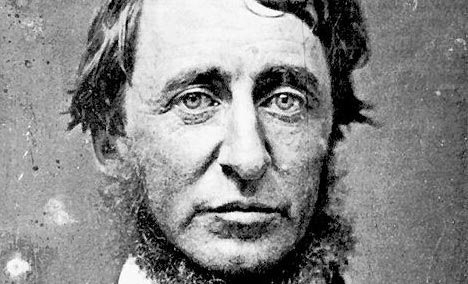
Friday, October 21, 2011

Put them all down?...

For when we think that progress is never made...

Thoreua in a letter to Harrison Blake: "They have a census table in which the put down the number of the insane. Do you believe that they put them all down there?

And this the accompanying note by Bradley Dean: "The 1850 Census forms had a column for "deaf and dumb, blind, insane, idiotic, pauper or convict'; the census taker in Concord listed two deaf and dumb, one blind, five insane, one idiotic, eight paupers, and five convicts among the 2,249 residents."

blessings

Tuesday, October 18, 2011

The common level...

One more from HDT...

"It is worth the while to live respectably unto ourselves. We can possibly get along with a neighbor, even with a bedfellow, whom we respect but very little; but as soon as it comes to this, that we do not respect ourselves, then we do not get along at all, no matter how much we are paid for halting. There are old heads in the world who cannot help me by their example or advice to live worthily and satisfactorily to myself; but I believe that it is in my power to elevate myself this very hour above the common level of my life."

blessings

Monday, October 17, 2011

Rotting potatoes...

This, briefly, from Thoreau's "Letters from a Spritual Seeker"

I have had but one spiritual birth (excuse the word,)and now whether it rains or snows, whether I laugh or cry, fall farther below or approach nearer my standard, whether Pierce or Scott is elected,-not a new scintillation of light flashes on me, but ever and anon, though with longer intervals, the same surprising & everlasting new light dawns upon me, with only such variations as in the coming of the natural day, with which indeed, it is often coincident.

As to how to preserve potatoes from rotting, your opinion may change from year to year, but as to how to preserve your soul from rotting, I have nothing to learn but something to practice.

Blessings

Saturday, October 15, 2011

home-made divineness...

My current devotional reading includes Thoreau's "Letters to a Spiritual Seeker," edited by the late Bradley Dean. It is a wonderful volume (not least for the copious notes provided by Dean) and vital in understanding Thoreau's religion. This morning I was deeply struck by the profound importance of "expectation" in HDT's thought and life...

"Is not the attitude of expectation somewhat divine-a sort of home-made divineness? Does it not compel a kind of sphere music to attend on it? and do not it's satisfactions merge at length by insensible degrees in the enjoyment of the thing expected?"

Blessings

Thursday, October 13, 2011

aspire...

Thoreau...

"If a man constantly aspires, is he not elevated?"

blessings

Wednesday, October 12, 2011

Let the beautiful laws prevail...


A little on the tired side today and thinking of a particular passage from Thoreau that I finally tracked down...

"Who are poor and dependent? Who are rich and independent? When was it that men agreed to respect the appearance and not the reality? Why should the appearance appear? Are we well acquainted, then, with the reality? There is none who does not lie hourly in the respect he pays to false appearance. How sweet it would be to treat men and things, for an hour, for just what they are! We wonder that the sinner does not confess his sin. When we are weary with travel, we lay down on our load and rest by the wayside. So when we are weary with the burden of life, why do we not lay down this load of falsehoods which we have volunteered to sustain, and be refreshed as never mortal was? Let the beautiful laws prevail!"

Amen and blessings

Saturday, October 8, 2011

The undulations of celestial music...

Thoreau's great call for living the day...

"The morning, which is the most memorable season of the day, is the awakening hour. Then there is least somnolence in us; and for an hour, at least, some part of us awakes which slumbers all the rest of the day and night. Little is to be expected of that day, if it can be called a day, to which we are not awakened by our Genius, but by the mechanical nudgings of some servitor, are not awakened by our own newly acquired force and aspirations from within, accompanied by the undulations of celestial music, instead of factory bells, and a fragrance filling the air--to a higher life than we fell asleep from; and thus the darkness bear its fruit, and prove itself to be good, no less than the light. That man who does not believe that each day contains an earlier, more sacred, and auroral hour than he has yet profaned, has despaired of life, and is pursuing a descending and darkening way. After a partial cessation of his sensuous life, the soul of man, or its organs rather, are reinvigorated each day, and his Genius tries again what noble life it can make. All memorable events, I should say, transpire in morning time and in a morning atmosphere. The Vedas say, "All intelligences awake with the morning." Poetry and art, and the fairest and most memorable of the actions of men, date from such an hour. All poets and heroes, like Memnon, are the children of Aurora, and emit their music at sunrise. To him whose elastic and vigorous thought keeps pace with the sun, the day is a perpetual morning. It matters not what the clocks say or the attitudes and labors of men. Morning is when I am awake and there is a dawn in me. Moral reform is the effort to throw off sleep. Why is it that men give so poor an account of their day if they have not been slumbering? They are not such poor calculators. If they had not been overcome with drowsiness, they would have performed something. The millions are awake enough for physical labor; but only one in a million is awake enough for effective intellectual exertion, only one in a hundred millions to a poetic or divine life. To be awake is to be alive. I have never yet met a man who was quite awake. How could I have looked him in the face?"

Blessings