Part of my devotions this morning included an early sermon by Ralph Waldo Emerson which, in turn, included this wonderful bit...
"We can hardly quote too often the beautiful saying of that man who knew so mush more than his fellow men, Sir Isaac Newton. "I don't know," he said, "what I may seem to the world, but to myself I seem to have been only like a boy playing on the seashore and diverting myself now and then finding a smoother pebble or a prettier shell than the ordinary, whilst the great ocean of truth lay all undiscovered before me."
blessings
Saturday, September 3, 2011
Friday, September 2, 2011
close to the road...
This from James Freeman Clarke's sermon, "Faithful Over a Few Things"
"But what is the meaning of the word "integrity "? It means thoroughness, entireness; putting the same quality of soul into everything, great and small. No one is a man of integrity who does not do every thing with the same nndeviating honesty, the same unbending principle. The man of real integrity puts the whole energy of conscience, faith, love, into the smallest act as into the greatest. So the steam-engine in a factory exerts the same tremendous power to cut in two an iron bar, or to stick a pin into a card.
Christianity does not allow us to trifle with anything. There is nothing trivial to the illuminated eye and heart of faith. He who says to his brother, "Thou fool!" is in danger of hell-fire. He is, in fact, already in hell-fire; for the feeling of contempt for his brother, the scorn and disdain which can thus reject from its sympathy a fellow-man, is itself the spirit of the pit...
I once heard of a...preacher, who used this plain but striking image in a sermon: "You think, my brethren, that you can go a little way out of God's road into the devil's field, and not be caught, provided you do not go too far. But the devil is not such a fool, when he spreads his nets and sets his traps for you, to put them away in the middle of his field. No: he puts them close to the road: so, if you mean to go a great way or only a little way, he is sure to have you in either case." The illustration was homely; but the doctrine is sound."
Blessings
"But what is the meaning of the word "integrity "? It means thoroughness, entireness; putting the same quality of soul into everything, great and small. No one is a man of integrity who does not do every thing with the same nndeviating honesty, the same unbending principle. The man of real integrity puts the whole energy of conscience, faith, love, into the smallest act as into the greatest. So the steam-engine in a factory exerts the same tremendous power to cut in two an iron bar, or to stick a pin into a card.
Christianity does not allow us to trifle with anything. There is nothing trivial to the illuminated eye and heart of faith. He who says to his brother, "Thou fool!" is in danger of hell-fire. He is, in fact, already in hell-fire; for the feeling of contempt for his brother, the scorn and disdain which can thus reject from its sympathy a fellow-man, is itself the spirit of the pit...
I once heard of a...preacher, who used this plain but striking image in a sermon: "You think, my brethren, that you can go a little way out of God's road into the devil's field, and not be caught, provided you do not go too far. But the devil is not such a fool, when he spreads his nets and sets his traps for you, to put them away in the middle of his field. No: he puts them close to the road: so, if you mean to go a great way or only a little way, he is sure to have you in either case." The illustration was homely; but the doctrine is sound."
Blessings
Thursday, September 1, 2011
a higher and holier life...
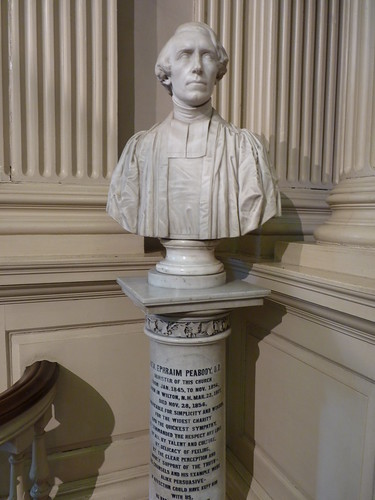
This from Ephraim Peabody's "Christian Days and Thoughts"
BEST HOURS.
There are seasons when, for the moment at least, the power of the world seems to drop. A strange and awful sense of responsibility comes upon us. Aspirations rise up out of the soul like the morning mist kindling in the sun as it rises from the mountain top towards heaven. We long for a higher and holier life. The vanity of the world, the worth of virtue, the goodness of God, and the peace of a trusting and devout heart are revealed to us. It is a heavenly vision open before the soul. These hours, when the soul is freed from its bonds, and holds communion with truth and God, and sees revealed the realities of its existence, are blessed hours—hours of heaven— hours which if obeyed shall raise the soul upward to heaven. Repel not the heavenly vision by disobedience. Sacrifice any thing rather than these heavenly impulses. Give up any thing that interferes with carrying them out into the life. These hours of the soul's communion with truth and God are the precious hours of life. They are the scattered fountains in the desert, at which the fainting traveller revives his strength and courage. Then heavenly voices speak, and happy is he who gives heed to the heavenly vision, which is from God, and conduces to God."
Blessings
BEST HOURS.
There are seasons when, for the moment at least, the power of the world seems to drop. A strange and awful sense of responsibility comes upon us. Aspirations rise up out of the soul like the morning mist kindling in the sun as it rises from the mountain top towards heaven. We long for a higher and holier life. The vanity of the world, the worth of virtue, the goodness of God, and the peace of a trusting and devout heart are revealed to us. It is a heavenly vision open before the soul. These hours, when the soul is freed from its bonds, and holds communion with truth and God, and sees revealed the realities of its existence, are blessed hours—hours of heaven— hours which if obeyed shall raise the soul upward to heaven. Repel not the heavenly vision by disobedience. Sacrifice any thing rather than these heavenly impulses. Give up any thing that interferes with carrying them out into the life. These hours of the soul's communion with truth and God are the precious hours of life. They are the scattered fountains in the desert, at which the fainting traveller revives his strength and courage. Then heavenly voices speak, and happy is he who gives heed to the heavenly vision, which is from God, and conduces to God."
Blessings
Wednesday, August 31, 2011
the deep places in life...
This from James Freeman Clarke's "The Christian Doctrine of Prayer"
" Experience. — Out of the Depths.
A further preparation may come to us out of the deeper experiences of life. We may pray sincerely, but superficially, from the surface rather than from the depths of the mind. We may pray from our perception of what is right and true, rather than from a deep feeling of it. But when we can say with the Psalmist, " Out of the Depths have I cried unto thee, O God !" then we have achieved also the moral preparation for prayer, the preparation of a moral experience. Then we acquire the habit of prayer out of the deep places of life, and the deep places of the heart.
There are deep places in life. For years we pass on in a circle of routine, until we reach a crisis. Sometimes years of cloudless prosperity are at once interrupted by a succession of troubles, as the smooth stream of a river ia broken by rapids and hurried suddenly down a cataract. The happy family is entered by Death, — father, mother, children, are snatched away from that loving circle. Love is disappointed, — hopes are frustrated, — prosperity ceases, — adversity comes, — sickness despoils us of our energies. In such hours we seem to descend, step by step, into still more profound depths of trial and sorrow. But from these depths the heart sees God more' clearly than from the sunny hill-tops of a happy life, — as persons can see the stars at midday from the bottom of a well. When all around us grows dark, the inward light grows stronger and clearer. When man deceives us, God is faithful. When Death approaches us outwardly, the idea of Immortal Life dawns, in pure auroral light, within the heart. In such hours we learn to pray.
But there are deeps lower than those of trouble and outward affliction, — moments in which, though no external trouble comes near us, inward joy departs. There are depths of scepticism which the soul of man has sometimes to pass, in his pilgrim's progress toward God, — depths in which we lose our faith in God, in man, in ourselves,— in which we ask for the meaning of the world, and find none, — in which all things seem full of vanity and emptiness, and we cause our heart to despair of all its labor which it takes under the sun.- Blacker than Egyptian darkness is this mental gloom, which sometimes settles, for a time, upon the purest and most aspiring minds, —
" A grief without a pang, void, dark, and drear,
A stifled, drowsy, nnimpassioned grief,
Which finds no natural outlet, no relief
In word, or sigh, or tear."
In this condition of scepticism, when we are like children lost in a forest, what can we do but cry to God ? This is the remedy, this the cure. It is not reasoning or argument which can help us in this disease, but Prayer. ' If we have faith enough left to cry to God, Peace and Light may then return to us."
Blessings
" Experience. — Out of the Depths.
A further preparation may come to us out of the deeper experiences of life. We may pray sincerely, but superficially, from the surface rather than from the depths of the mind. We may pray from our perception of what is right and true, rather than from a deep feeling of it. But when we can say with the Psalmist, " Out of the Depths have I cried unto thee, O God !" then we have achieved also the moral preparation for prayer, the preparation of a moral experience. Then we acquire the habit of prayer out of the deep places of life, and the deep places of the heart.
There are deep places in life. For years we pass on in a circle of routine, until we reach a crisis. Sometimes years of cloudless prosperity are at once interrupted by a succession of troubles, as the smooth stream of a river ia broken by rapids and hurried suddenly down a cataract. The happy family is entered by Death, — father, mother, children, are snatched away from that loving circle. Love is disappointed, — hopes are frustrated, — prosperity ceases, — adversity comes, — sickness despoils us of our energies. In such hours we seem to descend, step by step, into still more profound depths of trial and sorrow. But from these depths the heart sees God more' clearly than from the sunny hill-tops of a happy life, — as persons can see the stars at midday from the bottom of a well. When all around us grows dark, the inward light grows stronger and clearer. When man deceives us, God is faithful. When Death approaches us outwardly, the idea of Immortal Life dawns, in pure auroral light, within the heart. In such hours we learn to pray.
But there are deeps lower than those of trouble and outward affliction, — moments in which, though no external trouble comes near us, inward joy departs. There are depths of scepticism which the soul of man has sometimes to pass, in his pilgrim's progress toward God, — depths in which we lose our faith in God, in man, in ourselves,— in which we ask for the meaning of the world, and find none, — in which all things seem full of vanity and emptiness, and we cause our heart to despair of all its labor which it takes under the sun.- Blacker than Egyptian darkness is this mental gloom, which sometimes settles, for a time, upon the purest and most aspiring minds, —
" A grief without a pang, void, dark, and drear,
A stifled, drowsy, nnimpassioned grief,
Which finds no natural outlet, no relief
In word, or sigh, or tear."
In this condition of scepticism, when we are like children lost in a forest, what can we do but cry to God ? This is the remedy, this the cure. It is not reasoning or argument which can help us in this disease, but Prayer. ' If we have faith enough left to cry to God, Peace and Light may then return to us."
Blessings
Saturday, August 27, 2011
the wise man in the storm...
“The wise man in the storm prays to God, not for safety from danger, but deliverance from fear” Ralph Waldo Emerson
That said, I hope all stay safe...Blessings
Wednesday, August 24, 2011
My soul stretcheth...
My devotional reading this morning included this wonderful portion of Richard Lucas' (1648-1715) "An Enquiry into Happiness." I get a glimpse of what he speaks while praying in the quiet pews of our church and, often, in reading the Boston Unitarians. "My soul stretcheth"...
"It is true, I am but a Man, that is, a little Atom in the vast Matter, and my Life is but a short Moment in an endless Stream of Time: but then I feel a strange kind of Comprehensiveness in my Soul, it stretcheth forth itself to Times past and to come, it enjoys Things that, are not seen, by Faith and Hope, and sometimes Things that are not at all, by Memory and Fancy ; and tho' my Life is but a Moment, Satisfaction, and Pleasure hath it's Degrees and therefore if I can possess it in its Height and Perfection, I shall live much, tho' not long, I shall enjoy Eternity in a Moment, the World in a little Globe."
Amen and blessings
"It is true, I am but a Man, that is, a little Atom in the vast Matter, and my Life is but a short Moment in an endless Stream of Time: but then I feel a strange kind of Comprehensiveness in my Soul, it stretcheth forth itself to Times past and to come, it enjoys Things that, are not seen, by Faith and Hope, and sometimes Things that are not at all, by Memory and Fancy ; and tho' my Life is but a Moment, Satisfaction, and Pleasure hath it's Degrees and therefore if I can possess it in its Height and Perfection, I shall live much, tho' not long, I shall enjoy Eternity in a Moment, the World in a little Globe."
Amen and blessings
Tuesday, August 23, 2011
The mountain and the multitude...
James Freeman Clarke on praying without ceasing. (not sure he is quite fair to "monks and hermits") but the overall point is a good one...
"Prayer without ceasing.
The Apostles, in their Epistles, frequently refer to Prayer as a necessary part of the Christian life. Unceasing prayer is urged 1 Thess. v. 17. So Eph. vi. 18, " praying always" &c. Phil. iv. 6, " In every thing, by prayer and supplication, with thanksgiving, let your request be made known unto God." 1 Tim. v. 5, the widow is spoken of who continues in supplication and prayer night and day. Rom. xii. 12, " Contine in prayer." Col. iv. 2, " Continue in prayer, and watch in the same with thanksgiving." 1 Peter iv. 7," Be sober, and watch unto prayer." James v. 13, " Is any among you afflicted, let him pray : is he happy, let him sing psalms." Jude i. 20, " But ye, beloved, praying in the Holy Ghost, keep yourselves in the love of God."
This spirit of constant prayer was a natural growth of Christianity ; one peculiarity of which...was to insist on a permanent union of the soul with God, and an immanent presence of the Holy Spirit in the heart, instead of transient inspirations. Hence Christianity is spoken of as a Life ; as a constant, regular activity of the spiritual nature, — " the law of the spirit of life in Christ Jesus," — " eternal life abiding within us," — God and Christ "coming to make their abode in us." Such is the language of the New Testament.
Therefore, to pray without ceasing intends the unbroken union of the soul with God, so that all of life shall flow from God and to God. It does not mean a life like that of the monks or hermits, in which men retire from the world to devote themselves to formal acts of worship, and to make that the chief business of life : for such exclusive activity of the devotional element would not be as truly unceasing prayer as a life which alternates, like that of Jesus, between the mountain and the multitude. He who does nothing but pray is unable even to do this. His prayer necessarily degenerates into a form, into an outward routine, and so ceases to be prayer. When he takes himself out of life, where is the sphere of Christian duty, he loses the subject-matter for prayer. He has nothing to pray for, except in relation to the moods of his own mind, and therefore his prayer becomes wholly personal; and instead of praying out of an interest in Christ's kingdom, and the coming of his truth in the world, he prays only for himself. Therefore to pray without ceasing is to work for man in constant reliance on God ; to work for Christ, and in every moment of need to look to God for strength wherewith to work. While this habit of intercourse with God is maintained, while we thus bring all parts of our life before Him in thankfulness, penitence, or supplication, we fulfil the command to pray without ceasing."
Blessings
"Prayer without ceasing.
The Apostles, in their Epistles, frequently refer to Prayer as a necessary part of the Christian life. Unceasing prayer is urged 1 Thess. v. 17. So Eph. vi. 18, " praying always" &c. Phil. iv. 6, " In every thing, by prayer and supplication, with thanksgiving, let your request be made known unto God." 1 Tim. v. 5, the widow is spoken of who continues in supplication and prayer night and day. Rom. xii. 12, " Contine in prayer." Col. iv. 2, " Continue in prayer, and watch in the same with thanksgiving." 1 Peter iv. 7," Be sober, and watch unto prayer." James v. 13, " Is any among you afflicted, let him pray : is he happy, let him sing psalms." Jude i. 20, " But ye, beloved, praying in the Holy Ghost, keep yourselves in the love of God."
This spirit of constant prayer was a natural growth of Christianity ; one peculiarity of which...was to insist on a permanent union of the soul with God, and an immanent presence of the Holy Spirit in the heart, instead of transient inspirations. Hence Christianity is spoken of as a Life ; as a constant, regular activity of the spiritual nature, — " the law of the spirit of life in Christ Jesus," — " eternal life abiding within us," — God and Christ "coming to make their abode in us." Such is the language of the New Testament.
Therefore, to pray without ceasing intends the unbroken union of the soul with God, so that all of life shall flow from God and to God. It does not mean a life like that of the monks or hermits, in which men retire from the world to devote themselves to formal acts of worship, and to make that the chief business of life : for such exclusive activity of the devotional element would not be as truly unceasing prayer as a life which alternates, like that of Jesus, between the mountain and the multitude. He who does nothing but pray is unable even to do this. His prayer necessarily degenerates into a form, into an outward routine, and so ceases to be prayer. When he takes himself out of life, where is the sphere of Christian duty, he loses the subject-matter for prayer. He has nothing to pray for, except in relation to the moods of his own mind, and therefore his prayer becomes wholly personal; and instead of praying out of an interest in Christ's kingdom, and the coming of his truth in the world, he prays only for himself. Therefore to pray without ceasing is to work for man in constant reliance on God ; to work for Christ, and in every moment of need to look to God for strength wherewith to work. While this habit of intercourse with God is maintained, while we thus bring all parts of our life before Him in thankfulness, penitence, or supplication, we fulfil the command to pray without ceasing."
Blessings
Subscribe to:
Posts (Atom)