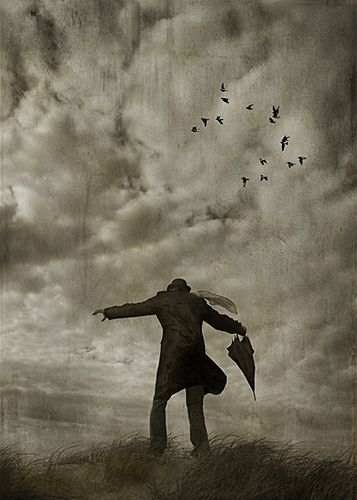
Four years or so ago, our youngest (Henry Emerson) created this picture just before Christmas. When I asked him about it he told me it was a picture of God saying "here he is!" "Look what I did"...(I have posted it the past two years on Christmas Day)
Jesus is born and all have a new birth. I hope everyone has a blessed Christmas day and can, now that the busyness of pre-Christmas is drawing to an end, take time to contemplate and receive the new spirit of the birth of Jesus. Here He is!
Blessings
Saturday, December 25, 2010
Thursday, December 16, 2010
only a holiday suit...

Brother Frothingham speaks of untried faith and the value of trials...His "Trials No Strange Thing" continued...
"Further, your faith is to be tested by calamities. Your faith, and not your morality only. Faith, that great confidence, which is so often confounded with the little peculiarities of sectarian opinion ; its divine elements being misapprehended among petty disputes, and its holy name taken to a falsehood. Whatever disadvantage falls upon us, serious enough to be called a trial, is meant to put to the proof our trust in God ; and a solemn proof it is, when applied to such a principle. It is easy to talk of this trust, when we speak without much reflection; when we intend little or nothing more than a general reference to the One Being, who is higher than ourselves and mightier than all. It is easy, out of the pleasant scenes of a well-furnished being, to say that we trust; when one half of the meaning is, that we are contented where we are, and the other half, possibly, that we have no little confidence in ourselves. But this is not the required thing. It is the merest acquiescence while there is nothing to disturb it. It is neither an earnest sentiment nor a deep seated principle. Profess it if you feel it. Wear it as long as it will hold together. But do not set much by it. It is only a holiday-suit. It has no portion yet of the sacred power that can weave sackcloth into a garment of dignity and praise, and scatter heavenly assurances among the dust and ashes in which the humbled heart must sit down. Losses show where you have laid up your treasure. Troubles show where you have established your rest. When your cup is filled from the earth's supplies, how can you perfectly know that the Lord is your portion? But when you find your strength small, your resources few, your hopes on this side of time faint, — when you are distracted with embarrassments and torn with pain, — then is the occasion for finding also the energy and the relief and the repose, that should be communicated by your faith."
Blessings
Monday, December 13, 2010
to prove, and not to destroy, you...
Brother Frothingham's Advent sermon, "Trials No Strange Thing" continued...
" Think it not strange," so run the words of the Apostle, " concerning the fiery trial that is to try you." You there read what is the design in view. It is to prove, and not to destroy, you. The very name expresses the object . Peter was speaking of the fire of persecution. He was warning his converts of the day when that should kindle upon them; banishing them from the comforts of their dwellings, and threatening to surround with literal flames the heads that were to be devoted to martyrdom for the Redeemer's sake. For us the fire is but a figure of speech. That persecution has spent itself long ago. But the figure has still an import, not less real, though not the same that it was ; and the existence of every one, whether he witnesses any good confession or not, is driven and distressed by some of the various ills that are abroad. A man is more likely to suffer for his transgression than for the truth ; but suffer he must . And that for no fault, often. It was assigned to him. And it is best so. At least he can make it to be best. When it burns against him to his greatest earthly loss, and as intensely as he can endure it, he is permitted to believe that it is no breaking out of a violent accident; that it is sent by the same Supreme Power who has set his glory in the heat of the sun, and who will make opposite things praise him equally. He is called upon, also, to assist by the exercises of his own will and heart the intentions of Providence; that its admonitions may not be lost upon him ; that its chastening may not have been inflicted in vain. It is not for him to choose in what manner his trial shall come. If it were, it would hardly be a trial. He would hesitate long, and choose the easiest, consulting his temperament, and making reserves against every thing that he should be most reluctant to undergo. He can only choose in what manner it shall be met ; whether with patience and constancy, or not; whether with the Christian endeavor to derive some moral advantage from it, or else with no care of such a sort; whether with tenderness or obstinacy; whether holding his integrity fast, or letting that go with the wreck of meaner things; whether trustfully, and committing all to the good pleasure of the Lord, or sullenly, and casting all as to the disposal of fate. Your character is to be put to its sharp tests; and how will it abide them ? You are tempted by pleasures and prosperity, to see if you are weak enough to be seduced. You are searched by hurts and deprivations, to see if you are strong enough to endure. That more cheerful experiment may fail, and instead of inspiring thankfulness and exciting to good works and encouraging sound principles, it may give empire to idleness and pride and every sensual passion. And if it does, the failure will be lamentable, though you will still have had your pastime; you can count up the shining bribes that corrupted you; you can show that you had gained something for what you surrendered; that the account was not wholly against you, if wretchedly uneven, of the world's good won and the soul ruined. The darker experiment may fail also ; breaking you down instead of bracing you up; making you but all the worse,— harder where it should have penetrated you, and wilder where it should have brought you under subjection ; and revealing that there is no true force in you. But if it does this, it will not leave you even the poor comfort that was allowed to the other case. There is nothing that you can mention as an offset to the unbalanced misery. You have not even a faded delight to hold up to us, and tell us how fresh it once was with the dews of its youth and the glow of its beauty, making us think that it would be almost worth any thing less than the boundless sacrifice it cost. Here it is all unhappy, both the method and the effect. You suffered in what was sent, and you suffer more in your perversion of it. It was bitter to take, and has only increased your malady."
Blessings
Friday, December 10, 2010
the angels laugh...

The Episcopal Church today celebrates the provisional feast day (and the anniversary of the death) of the theologian Karl Barth. In a reaction to the prevailing theological liberalism of his day, Barth, in his "The Epistle to the Romans" and, of course in his magnum opus, "Church Dogmatics" argued for the complete otherness of God and His perfect revelation in Jesus Christ. An author of the Barmen Declaration, Barth stood for Christ against Hitler and became a founder of the Confessing Church.
Feast Day Prayer:
"PRAYER Almighty God, source of justice beyond human knowledge: We offer thanks that thou didst inspire Karl Barth to resist tyranny and exalt thy saving grace, without which we cannot apprehend thy will. Teach us, like him, to live by faith, and even in chaotic and perilous times to perceive the light of thy eternal glory, Jesus Christ our Redeemer; who livest and reignest with thee and the Holy Spirit, ever one God, throughout all ages. Amen."
He was not without humor. His "Dogmatics" is comprised of numerous difficult (to say the least) volumes. He once said to a student:
"The angels laugh at old Karl. They laugh at him because he tries to grasp the truth about God in a book of Dogmatics. They laugh at the fact that volume follows volume, and each is thicker than the previous ones. As they laugh, they say to one another, ‘Look! Here he comes now with his little pushcart full of volumes of the Dogmatics!’—and they laugh about the persons who write so much about Karl Barth instead of writing about the things he is trying to write about. Truly, the angels laugh.”
and one more quote:
"To clasp the hands in prayer is the beginning of an uprising against the disorder of the world." Karl Barth
RIP and Blessings
sure that the Lord reigns...
Back to Brother Frothingham tomorrow. Today, some Friday JFC (James Freeman Clarke)...
"THE wonderful description of charity, by the apostle Paul, is not rhapsody or declamation; nor is it the account of an ideal super-angelic state, impossible for us here, but to be reached in some heavenly world. This divine power of love is possible for us all. Only let the love of God and man enter the soul, and you have in you the elements here described. You will find it not difficult to "suffer long and be kind." It will seem a simple thing not to envy, not to boast, not to behave unseemly, not to be always seeking your own. Whereas before you were easily provoked, now you smile at provocation, and are unruffled by injury. You become able to "bear all things," to "believe all things," to hope for all good in the midst of evil, and to " endure all things" to the end, patient because sure that the Lord reigns."
Blessings
(photo: daughter Molly's award winning photograph)
Thursday, December 9, 2010
a league and covenant with disaster...
Some direct truth from Rev. Frothingham in his sermon, "Trials No Strange Thing" (continued)"But there is another, in more direct accordance with the sentiment that the text means to convey. It is, that the afflictions of life, though few when set by the side of the innumerable kindnesses, that flow without ceasing and are so continuous as to be unregarded, are yet neither uncommon nor light. They form a regular part of the great system of heavenly appointments, in which we, with our changing circumstances and vanishing life, are included. They are more impartial than they are supposed to be. They spare none. They assail the most envied conditions. They are not to be bought off by the opulent, nor fought off by the strong. They trample upon the presumption of human abilities of every kind, and despise title and place. Science can bring none of its devices to bear upon them. Innocence itself can afford solace only, no defence, against their invasions. Where they appear not, they are; for they devour in secret, as well as smite openly. Some of the worst misfortunes are carried in the bosom, hidden from the eyes of the world, and saying nothing to their neighbors. We do but take our part, then, in a common decree, be there laid upon us as much as there will. We exclaim at one time, How mysterious! and at another, How singularly hard! when a little more reflection would make the mystery as plain as most of the other passages in our experience, and a little closer observation would resolve the singularity into one of those general laws that overrule the destinies of mortals. It may be strange for you, that this or that sad necessity has to be encountered, because you have never met it before, or because it is so different from what you ever apprehended; but it is not strange in the mixed throng of human vicissitudes. Here is a sorrow for you, and there is one for the person who happens to stand next to you. Your own you are sufficiently conscious of, and are more likely to overrate than to forget it; while of his you have little or no intimation, and perhaps could scarcely estimate it if he should tell it to you. We are very selfish, for the most part, in our troubles. Our bad fortune, like our good deeds, we indulge with large places in our memories. The blessings of every day, like its failures in duty and its ordinary sins, we easily leave out of any careful recollection. It is stranger than any of the crosses with which it may please God to intercept you, that you should be so unready for them, and so impatient at them; that you should be amazed and utterly despairing; that you should expect to be without your part of " the yoke that is upon all the sons of Adam "; that you should boast of to-morrow as if its event were assured, and live as though you had made a league and covenant with disaster; that you should forget the tenure by which you possess the things of time, forget the great lot of humanity in the resentment of personal afflictions, and forget the purpose of Heaven, that trains its subjects and its heirs by tasks and labor, sacrifice and wholesome fear, the tediousness of discipline and the smart of correction."
Blessings
Tuesday, December 7, 2010
the open hand of Providence...
Rev. Frothingham's sermon, "Trials No Strange Thing" continued...
Strange " you call it. And this word of yours implies, in the first place, that you are on the whole graciously dealt with ; that the order of things which encircles you, and holds you up, and carries you forward, is on the whole merciful. For why else should you find fault with what afflicts you, as if it were a departure from that order? Why else should you have so much as called it by the word you have used ? Why else should you have allowed yourself in the expectations that have been brought to nothing? Thus, your very complaint is proved to arise out of a condition that is a favored one; for you would never have thought of making that complaint but for your encouragements. You confess, then, that the usual course of events is not hard and depressing. And if you confess, how shall we forget it, — that this usual course is of just such a character as to show its general benignity, at the same time that it may put you or me to grief? It justifies abundantly all the good endeavors of men. It cheers on their hopes. It is full of rewards for those who will deserve them. The hand of Providence,— how much oftener it is open to give, than clenched to strike! It takes our small interests into its capacious care. It covers our weakness with its mighty protection. It condescends to lead us, receiving our feeble fingers into its eternal clasp. It is never weary of furnishing us with supplies. Do you not prove yourselves unreasonable, therefore, if you chide with it, when it withholds your desire or withdraws your dependences or admonishes you with its unwelcome dispensations? If it were a strange thing that you are called to suffer, — as indeed in a sense it is, when you compare its occasional occurrence with the steady stream of your benefits,—this would be so far from excusing a murmuring heart, that it should be a ground of thankful acknowledgments. And this is one side of our subject that is worthy of our attention."
Blessings
Subscribe to:
Posts (Atom)