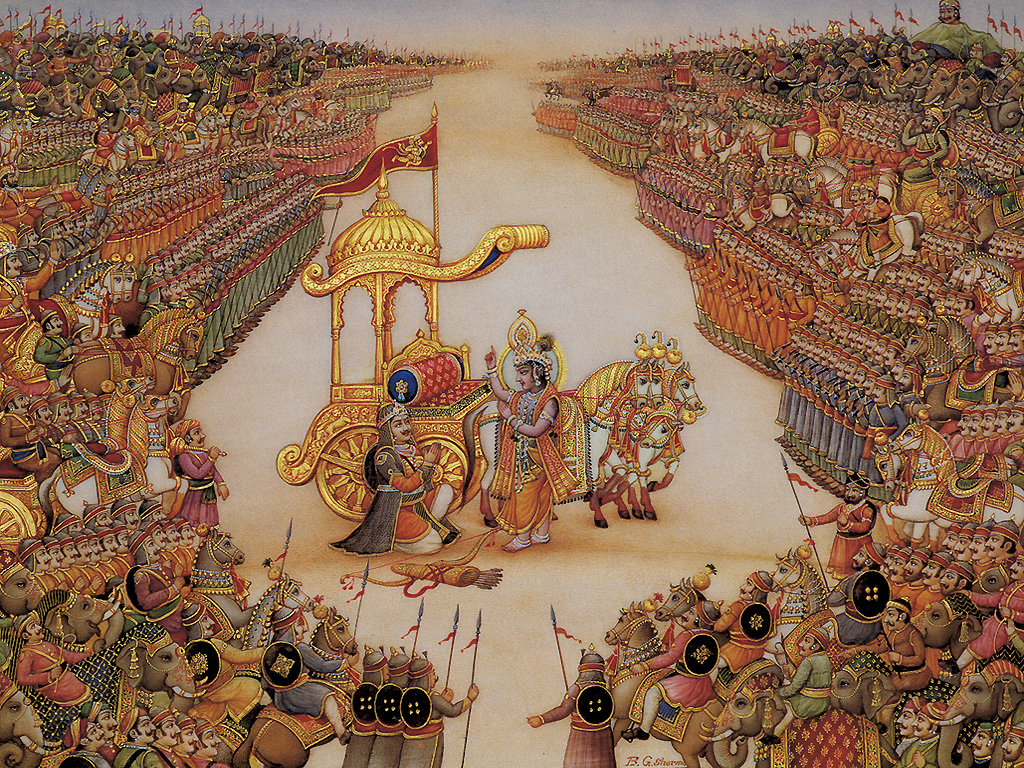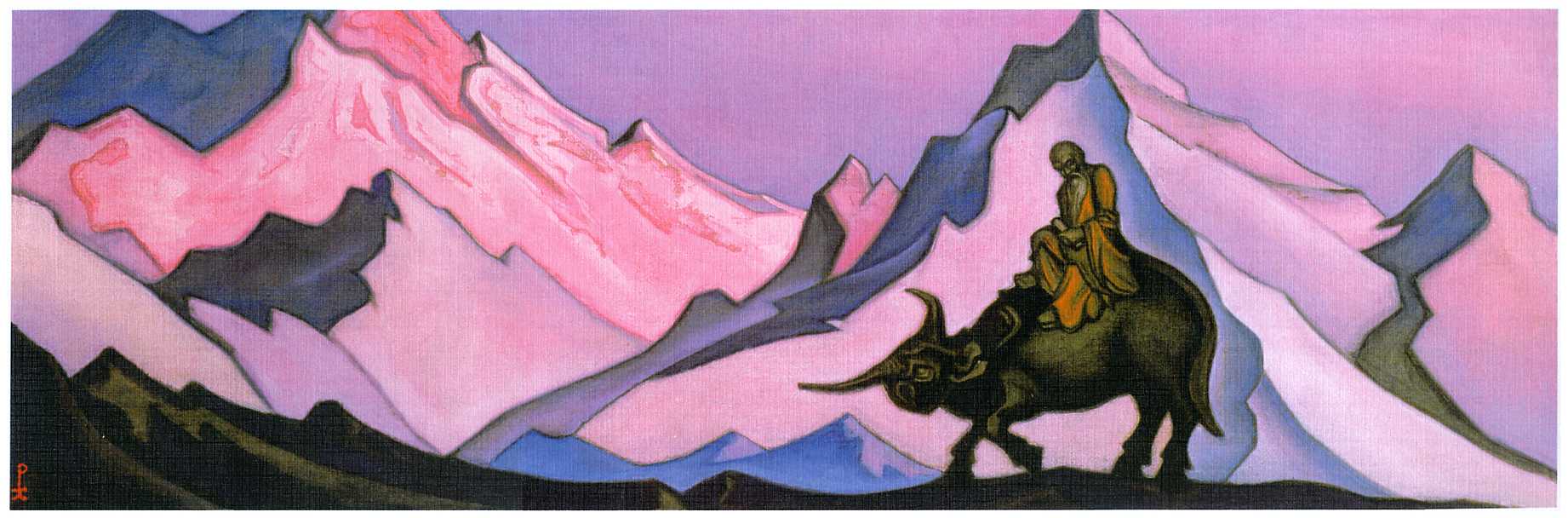
The well know opening verses of the "Tao Te Ching" (translated by James Legge) followed by the words of Ralph Waldo Emerson as arranged by Richard Grossman in his "The Tao of Emerson."
"The Tao that can be trodden is not the
enduring and unchanging Tao
The name that can be named is not the
enduring and unchanging name
Conceived as having no name
it is the Originator of heaven and earth
Having a name, it is the Mother of all things
Always without desire we must be found
If its deep mystery we would sound
But if desire within us be
Its outer fringe is all we shall see
Under these two aspects
it is really the same
But as development takes place
it receives the different names
Together we call them the Mystery
Where the Mystery is the deepest
is the gate of all that is subtle and wonderful"
RWE:
"That great nature in which we rest
that Unity, that Oversoul
Is an immensity not possessed
and that cannot be possessed
The animal eye sees with wonderful
accuracy
sharp outlines and colored surfaces
To a more earnest vision
outlines and surfaces
become transparent:
Causes and spirits
are seen through them
The wise silence,
the universal beauty
to which every part and particle
is equally related
Is the tide of being which floats us
into the secret of nature;
And we stand before
the secret of the world."
Blessings
Thursday, September 23, 2010
Wednesday, September 22, 2010
mysterious but remarkable...
"The Tao of Emerson" by Richard Grossman arranges the words of "the sage of Concord" alongside the words of the Tao Te Ching in the belief that Emerson's writings, "in a mysterious but remarkable way...contain the essence" of the Tao. Controversial and yet appealing are efforts to seek similarities in religious vision (witness the current interest in Stephen Prothero's "God is Not One." (a particularly good review by Dan Harper in the UU World here) I share the reservations yet think the effort is usually for the good. Grossman's effort is fascinating. This from the introduction:
"These two men, separated in history by nearly 2500 years, one a citizen of the worlds oldest empire and the other of one of its youngest republics, were sages whose messages were remarkably alike: live the simple, tranquil life, trust your intuition; find and revere the spiritual grace in the natural world; act without self-assertion; commit no violence against living things or persons; try to harmonize with the ebb and flow of nature and circumstance-and above all, assure that there is a place in the world for humility, yeilding, gentleness, and serenity."
Over the next few days, some excerpts...
Blessings
Tuesday, September 21, 2010
the sweet tone of the Spirit...
Cyrus Bartol was not a fan of ritual and form in worship as made clear in this continuation of "The Word of the Spirit..."
"The Spirit, then, is our only authority. If I were going to name a church, it would not be Church of the Trinity or Unity, of the Disciples or the Episcopate, of Saints or Souls, nor even of the Messiah or Saviour, dear unspeakably as these titles may be; but of the Spirit whence Messiah and Saviour drew. Be we apart or together, let us mind the Spirit. Let us look and listen for it. Let us meditate and pray till it arrive, and unveil itself to cheer us. The reason we do not hear and receive it more is the tumult we are in of other things. Late at night, some time ago, six miles off, I stood waiting near the tower of a village-church. The clock struck. The mellow vibration continued after the hammer stopped, till I was amazed at its long duration. If other earthly noises are not allowed to encroach too much, the Spirit, with sweeter tone than of any instrument, will continue sounding in our souls.
" He that hath an ear," —that is, everybody,— " let him hear what the Spirit saith unto the churches." We all have an ear, deeper than of the flesh, hearkening to something beneath all bells and breezes, tongues or outward motions. It is the dearest desire of my heart, if I know what it is, that we Congregationalists should be a church of the Spirit, in this finer hearing. Our service is called bare and meagre. We must bear the reproach. Doubtless the sonorous, priestly intoning and responding from sabbath to sabbath of the same idolized words (is not the idolatry of words as bad a violation of the command as that of graven images ?) would, in the weakness of human nature, win greater crowds, filling the seats, and stir them to a more vivid superficial delight. But would it be spiritual and profitable to the soul ? I think not; and I thank God, as a Congregationalist, for our joint success, and our hope still to prosper, without such alluring accessories, not in the gospel, which might convert people to us, and not to him. Let us trust his Spirit. With combined and separate entreaty, let us beseech it. In our life, let us obey it. For the building of our character, unseen and mysterious as it is, let us rely on it. The stout and aged woods grow from invisible gases of earth and air. Breathing what we never saw fashions and sustains our own fearful and wonderful frame. To this city and Jerusalem of our abode, wide acres yonder, pushing out the tide, are added by a puff of transparent steam, turning the iron wheels that roll hills, interior and out of sight, into sea-side, solid plains to hold up streets and dwellings and courts of the Lord. Could we open ourselves to the working of that marvellous force, which exceeds all the elements of nature and applications of art, there would be a moral result transcending material growth and human structures, as eternal glories shame the triumphs of sense and of time."
Blessings
Monday, September 20, 2010
beams of the resplendent orb...
This on Cyrus Bartol from Octavius Brooks Frothingham. "His Transcendentalism had a cast of its own; it was not made after any pattern; it took its color from an original genius illuminated by various reading of books, and by deep meditation in the privacy of the closet, and the companionship of nature of which he is a child-like worshipper."
Bartol's "Word of the Spirit" continued:
"I beg you, my reader, to consider, then, that there is something in you beside yourself. There is something in the air around you, not of the atmosphere, which the chemist cannot solve. There is a light, not of the sun, lighting every man that cometh into the world. There is a voice beyond that of man or nature, gentler than the softest whisper in counsel to us, and louder than the rending thunder in our remorse. There is a feeling of present divinity, of which we are never quite rid. There is a being we are conscious of above our own, ordaining, supporting, commanding, awing, consoling, teaching, blessing it. In our solitude there is another with us; and, in our society, One, invited or uninvited, not counted in the list or written on the cards. It is the Spirit. The flash of truth in you, the path of honor pointed before you, the impulse of justice to walk therein, your act of goodness, your abstinent purity, — these are all from it. Your thought of perfect kindness, may God give it! — your flame of holy love, may God kindle it! — your swifter than arrow's flight of ascending prayer, — did you make these with your cunning contrivance, your curious fingers, and of your own potent will ? No: the Spirit breathed them into you. Part and parcel of the Spirit they are. They alone are intrinsic evidence, that all your ideas of a great Father's yearning, of a higher state for your departed ones, as being dearer to him than to yourself, are not vanity. I did not make my love: then a higher Love made it, and will justify it for ever. You did not create your own apprehensions of Eternal Purity and Goodness: you, then, may trust and hope in them, spite of sorrow and death, to enliven and save and keep you world without end. They are beams which, followed, must bring you to the resplendent orb. They are the essential stuff of which the universe is formed, without which there would be no universe ; and in them you are immortal and everlasting."
Blessings
Sunday, September 19, 2010
independent dependents...
Cyrus Bartol, a member of the Transcendental Club speaks for the simple and final authority of the Spirit in his "The Word of the Spirit to the Church" (part one):
"Let us heed only such teachers as refer us, not to their creed, their assembly, their style or book of worship, as final or sufficient; but to the Spirit of truth, beauty, goodness,— the universal, infinite, pure, and loving Spirit of God...
The Spirit itself has necessary external channels, — temples, rites, and appointed days, — as well as a secret apparition. All Christians practically own the need and value of some sensible method and concerted order of praise, prayer, and teaching, for united and affectionate devotion. Nevertheless, we may consistently disown, and discard from our practice, and resist, that imposition of the pomp and excess of ritual which eclipses the hidden Deity, and drowns his whisper in the heart. Indeed, my aim in this essay is, against all lower judgments, to affirm the existence of a great and growing number in the community, for whom the plainest style of adoration is the best. We, Independents, in our dependency on God, deny that any more of mechanism and repetition and symbolic display than we already possess and use is needful or would be profitable for ourselves or our children. Men are, indeed, still too gregarious...
Undoubtedly there are ways and means, as well as a direct illumination, of the Spirit; but the Spirit is not to be limited to ways and means of any name or kind or number. What the procession of that Spirit is, when it began, how far it goes, how many minds or ages it includes, or where it shall end, who shall tell? Jesus did not commence it; historical Christianity did not create it; it is uncreated. All its prophets have never been mentioned to us. To make us more sensible of it is the office of our faith. I can only, in a few poor words, indicate its presence or describe its work."
Some of those "few poor words" tomorrow... Have a blessed Sabbath.
Saturday, September 18, 2010
the like-minded...
Tomorrow marks the anniversary of the first meeting of what has come to be known as the Transcendental Club. Begun in 1836, the Club (know by many names and consisting of shifting participants) was a breeding ground for the transcendental movement. Boston Unitarians, of course, were its primary participants and its most vehement critics. Frederick Henry Hedge was a founder but later felt that many of the "transcendentalists" went too far. Here is Hedge on the Club:
"In September, 1836, George Ripley, Waldo Emerson, and myself called the first meeting of what was named in derision 'The Transcendental Club.' There was no club in any strict sense, — only occasional meetings of likeminded men and women. No line was drawn between those who were members and those who were not, except that as a matter of course certain persons were always notified. Emerson, Alcott, Thoreau, Stetson, George Ripley and his wife, Mrs. Samuel Ripley, Margaret Fuller, John S. Dwight, Elizabeth Peabody, Theodore Parker, Jones Very, Robert Bartlett, John Weiss, Dr. Francis, Dr. Bartol, and myself, were expected. Orestes Brownson met with us once or twice, but became unbearable, and was not afterward invited. George Bradford, Samuel Osgood, and Ephraim Peabody were sometimes present . Dr. George Putnam came to one of these meetings, — in fact, was one with Ripley, Emerson, and myself, to start them; but they took a turn unexpected to him, and after the first meeting at Emerson's he ceased to come. My coming from Bangor, where I then resided, was always the signal for a meeting." (love the bit about Orestes...)
Of course regular participant James Freeman Clarke would later say that the group called themselves " the club of the likeminded, I suppose, because no two of them thought alike."
blessings
Thursday, September 16, 2010
the doubter and the doubt...
Ralph Waldo's "Brahma"...
"Brahma
If the red slayer think he slays,
Or if the slain think he is slain,
They know not well the subtle ways
I keep, and pass, and turn again.
Far or forgot to me is near,
Shadow and sunlight are the same,
The vanished gods to me appear,
And one to me are shame and fame.
They reckon ill who leave me out;
When me they fly, I am the wings;
I am the doubter and the doubt,
And I the hymn the Brahmin sings.
The strong gods pine for my abode,
And pine in vain the sacred Seven;
But thou, meek lover of the good!
Find me, and turn thy back on heaven. "
Blessings
Subscribe to:
Posts (Atom)

.jpg)